Stroke Warning: This Could Be You, Soldier Recovers from Stroke
May Is Stroke Awareness Month
Related Media
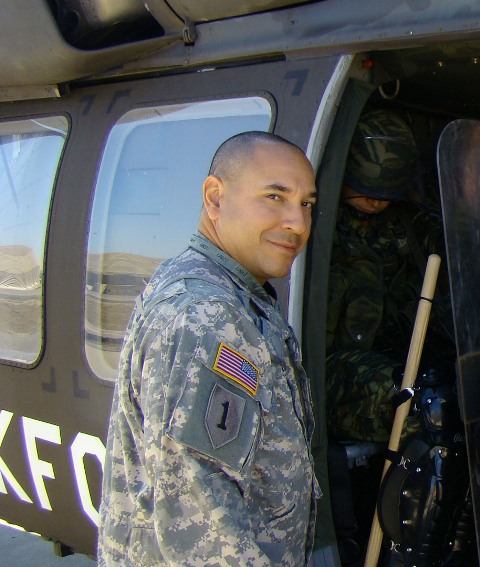
Sgt. Daniel J. DelaPeña of Gurnee, with B Company, 1st Battalion 106th Aviation Regiment at Chicago Midway Airport, suffered a stroke in June of 2010 and now serves as a stroke awareness advocate.
CHICAGO, IL (05/10/2012)(readMedia)-- Roughly 100,800 times a day, blood flows normally and the body functions at 100 percent. Blood is pushed into the heart and lungs and then is sent to nourish the rest of the body. This complicated process all happens in a matter of seconds in the average person.
Suddenly, the body senses a problem with the blood flow. An artery has a tear in the lining and blood effuses outside the normal circuit. Arteries quickly vasodilate to compensate for the lost blood, but this cannot reverse the damage to the artery. The body goes into panic to try to give the brain oxygenated blood. Vital brain cells start dying and the body starts to malfunction. The body has suffered a stroke and it needs immediate attention before brain damage is permanent.
Many Americans would not recognize the beginning signs of a stroke, just like Sgt. Daniel J. Delapeña of Gurnee, Black Hawk crew chief of B Company, 1st Battalion 106th Aviation Regiment at Chicago Midway Airport.
Delapeña served as the third-shift supervisor line service at the Waukegan Airport. On June 14, 2010, he realized something was wrong. He kept trying to pick up a set of keys, but his fingers would not grasp and he kept dropping them. He then tried to walk outside, but he kept going left and bumping into things.
"It was like my GPS was off or something," said DelaPeña.
The symptoms continued through the night and a co-worker decided to research DelaPeña's ailments. The co-worker told DelaPeña he had the symptoms of a stroke, but DelaPeña was resistant to the idea and attributed his symptoms to lack of sleep. DelaPeña's wife told him to go to the hospital to get checked out.
"My wife came home and took me to the hospital," said DelaPeña. "They did a CT scan on my brain, and that's when I found out I had a stroke. Before I knew it, I was in an ambulance to go to Lake Forest Hospital."
To avoid permanent brain damage, DelaPeña entered physical therapy to rehabilitate his body. He also changed his daily routine to contribute to stroke prevention by exercising and eating right.
"I live in Chicago, home of the deep dish pizza, and now instead of eating half of a pizza, I only have a slice," said DelaPeña Preventing a stroke is possible. According to the National Institute of Neurological Disorders and Stroke, treatable risk factors for stroke are hypertension, cigarette smoking, heart disease, warning signs or history of stroke, diabetes, cholesterol imbalance and physical inactivity or obesity. Treating any of these will reduce the risk of stroke.
DelaPeña not only needed help rehabilitating physically, but also mentally. He joined a stroke support group to learn about stroke prevention and help others coping with injuries from a stroke.
"He is the most resilient survivor. His family is extremely important to him and he is important to his family. I am certain this may not be the easiest time in their lives, but I am certain they are collectively supportive of one another," said Capt. Oluwatoyin O. Hines of Chicago, 108th Battalion Chaplain and Wounded Warrior Ministry Chaplain for the Illinois Army National Guard.
Early detection of symptoms is the best way to avoid permanent damage.
According to the Mayo Clinic, if someone feels sudden trouble walking, speaking or understanding speech; paralysis or numbness on one side of the body or face; trouble seeing in one or both eyes; or sudden severe headache, he or she should seek medical attention immediately.
With the help of his support group and family, DelaPeña has fully recovered and still serves in the Illinois Army National Guard.
"He is a fighter; a true representation of a Soldier standing strong in spite of personal and medical obstacles," said Hines, a Chicago native. "He is another promising reminder that Soldiers are capable of conquering the most difficult moments in our lives. He has proven it like many others: stay strong, we are strong with you."
For more information on the prevention or management of a stroke, visit The National Institute of Neurological Disorders and Strokes at http://www.ninds.nih.gov/index.htm
Story by Spc. Kristi L. Goodin, 139th Mobile Public Affairs Detachment
Illinois National Guard
National Guard PAO Illinois , (217) 761-3569, ngilstaffpao@ng.army.mil, News Release #109-051012


Recent News
- CHRISTMAS AT THE FRONT
- Naperville Native promoted to Major
- Chatham Soldier Promoted to Sergeant First Class
- Specialized Illinois National Guard Unit Mobilizes for Afghanistan
- MEDIA ADVISORY: Illinois National Guard Team Mobilizes for Afghanistan
- Illinois Ready: Prairie Assurance Exercise 2018
- ILLINOIS NATIONAL GUARD CONDUCTS MAJOR EARTHQUAKE EXERCISE
- Decatur Soldier recognized for achievement
- Berwyn Soldier Promoted to Specialist
- Chicago-based Illinois National Guard unit mobilizes for Iraq
...more