

Sussex Resident Rory Cooper Will Spend Five Months Living with an Indigenous Community in Chile
Related Media
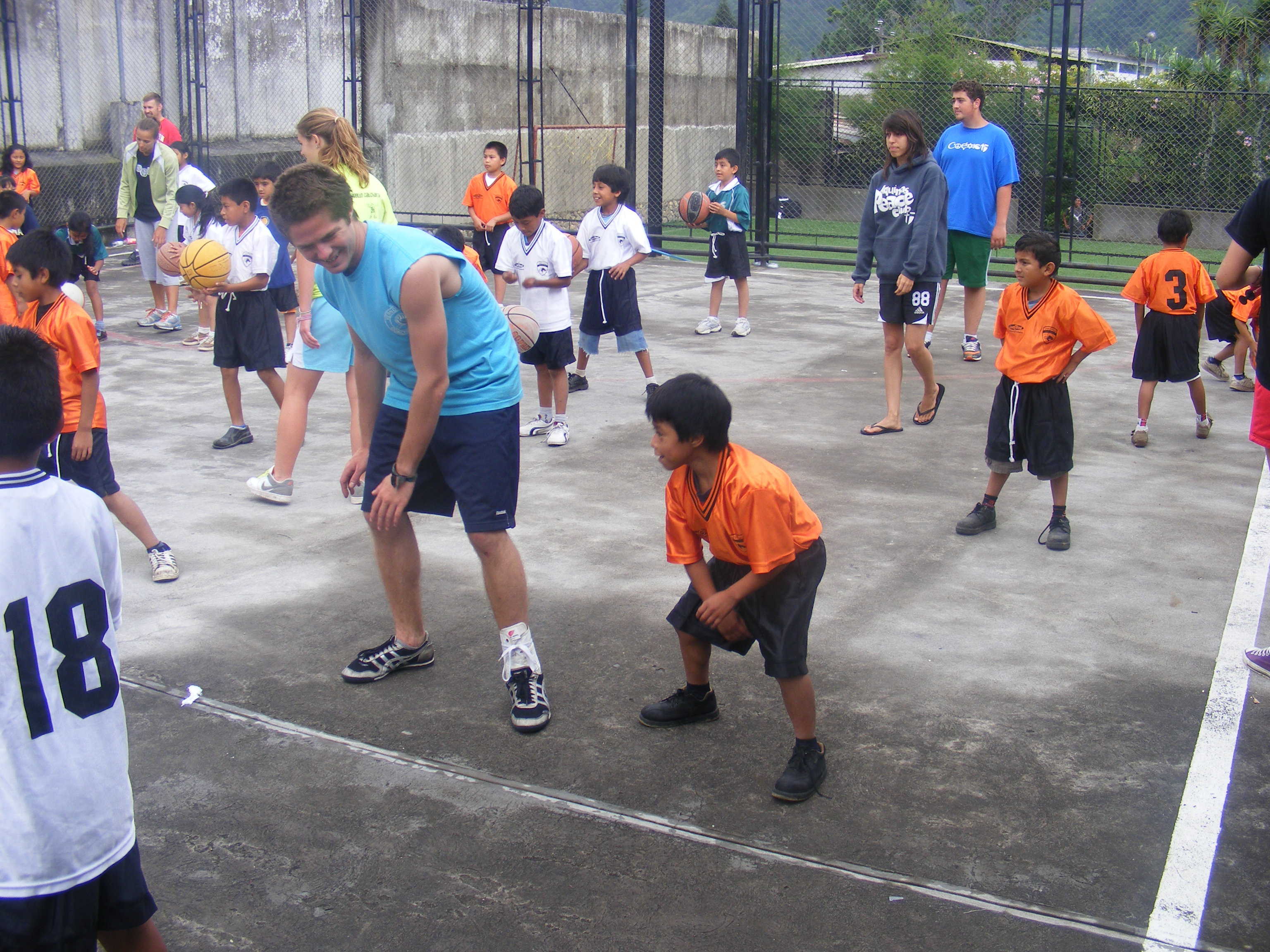
Sussex resident Rory Cooper assists in a basketball clinic held last summer for students at a local school in San Lucas, Guatemala. Cooper was a volunteer at the Juan Ana Coffee Project.
ITHACA, NY (07/14/2011)(readMedia)-- Ithaca College student Rory Cooper, son of Sussex residents Tim and Rosemary Cooper, will leave for South America in August to start a five-month residency with the indigenous Mapuche community in southern Chile. A senior majoring in culture and communication, Cooper is bound for Chile through SIT Abroad, a program of world learning based in Brattleboro, Vermont. The purpose of his 5,500-mile journey is to get a firsthand look at the interrelationships between cultural identity, social justice and community development.
"Though I've never been to Chile, I did live in Guatemala last summer, working at the Juan Ana Coffee Project in the little town of San Lucas," Cooper said. "I became a big fan of the pace and approach to life that I encountered there, and from what I heard from friends, Chile was also a really cool place, with mountains, beaches, an extraordinarily diverse collection of natural ecosystems as well as rich cultural history. It just so happened that SIT Abroad offered a program that seemed right up my alley, and now I'm on my way."
While in Chile, Cooper plans to use an HD camcorder to record his experiences, which he'll edit into a documentary he'll present at the annual meeting of the Wilderness Education Association and the National Conference on Undergraduate Education in Ogden, Utah. "Right now, what will result from my study is a mystery to me, but I hope to unveil some common ground between the two extreme sides of conservation and industry."
After graduating from Ithaca College next May, Cooper foresees himself doing conservation work in the Southwestern United States.
"I've been able to take advantage of the wide array of opportunities at Ithaca College over these past few years," Cooper said. "Choosing courses in the Culture and Communication and Outdoor Pursuits Programs has allowed me to build my studies around issues that interest me. Among them is examining the effects that living in a globalized and industrialized world has had on indigenous and traditional peoples and lifestyles. With all the problems we face today with regards to environmental degradation, resource scarcity and socioeconomic inequalities, it's clear that the path we are headed on has major faults that can no longer be ignored or brushed aside. By examining other models for living, perhaps we can find some way to move forward to make a better world for everyone."
Ithaca College
Keith Davis, 607-274-1153


Recent News
- Ithaca College Students Named to Spring 2023 Dean's List
- Ithaca College Congratulates December 2022 Graduates
- Ithaca College Students Named to Fall 2022 Dean's List
- "IC on Broadway: South Hill State of Mind"
- Ithaca College Students Named to Spring 2022 Dean's List
- Ithaca College Congratulates May 2022 Graduates
- Ithaca College Students Named to Fall 2021 Dean's List
- Ithaca College Congratulates December 2021 Graduates
- Ithaca College Congratulates May 2021 Graduates
- Ithaca College Students Named to Spring 2021 Dean's List
...more

