

NY Army Guard honors Soldiers killed during Lake Champlain battle during Saratoga National Cemetery ceremony
Media Advisory for October 13, 2026 event at Saratoga National Cemetery
Related Media
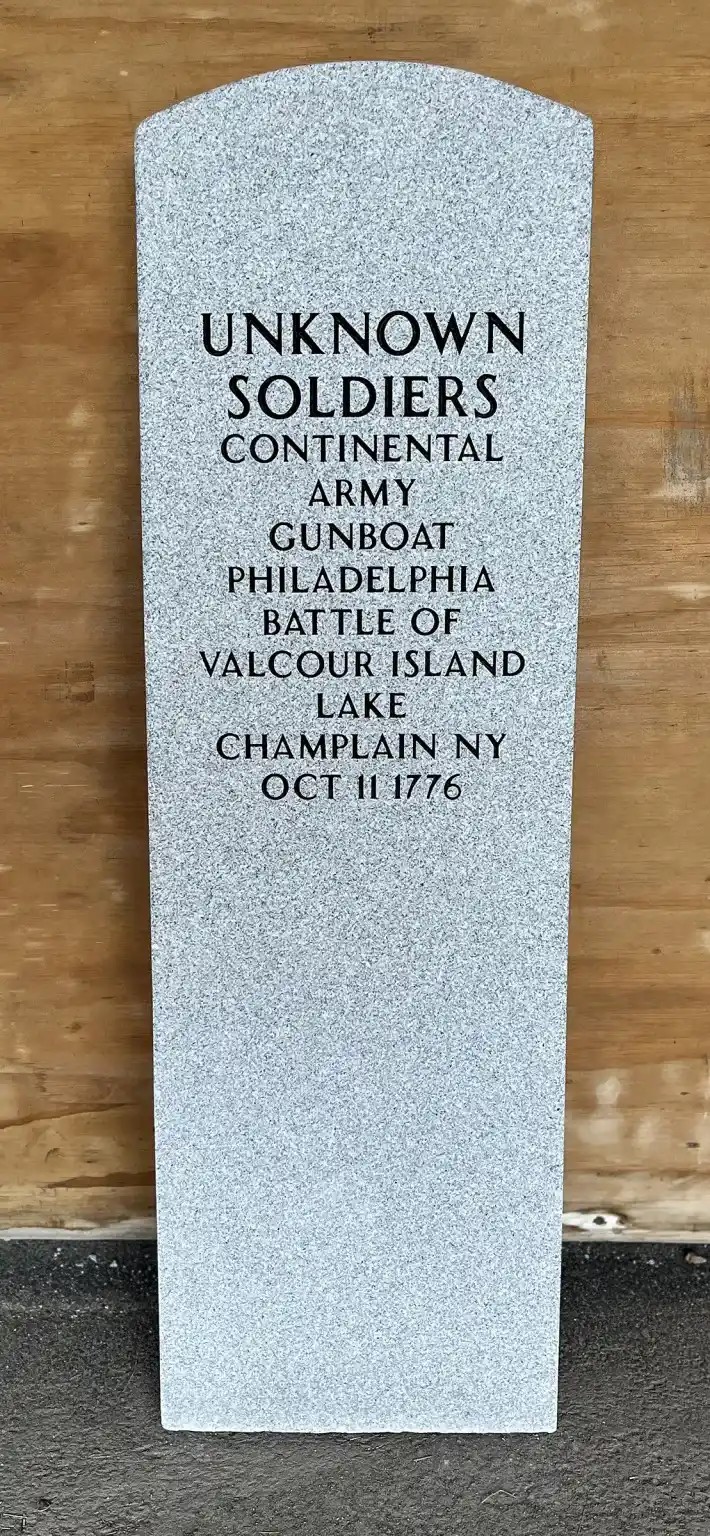
This marker will be placed on the gravesite holding the remains of one or more Soldiers who fought at the Battle of Valcour Island.
SCHUYLERVILLE, NEW YORK (10/09/2026) (readMedia)-- SCHUYLERVILLE, New York-The remains of New Hampshire Militia Soldiers killed during a naval battle on Lake Champlain on October 11, 1776, will be interred at Saratoga National Cemetery by a New York Army National Guard Honor Guard on October 13, 2026.
Forty-four Soldiers crewed the gunboat Philadelphia which was sunk during the Battle of Valcour Island. Researchers believe five died during the battle. The Philadelphia was one of 15 vessels in a fleet commanded by Benedict Arnold which was trying to stop a British fleet heading south on Lake Champlain.
The gunboat was raised in 1935, and some bones and a skull fragment were discovered along with human teeth.
The teeth are being interred.
Members of the press are invited to cover the interment ceremony.
WHO:
- Soldiers assigned to the New York Army National Guard's Honor Guard;
- Major General Ray Shields, the adjutant general of New York;
- Kenneth Cohen, division chair and curator of early American history, Division of Military and Society, from the Smithsonian Institution;
- Jennifer L. Jones, curator and project director, Gunboat Philadelphia Project, Division of Military and Society from the Smithsonian Institution;
- Representatives of the National Park Service from Saratoga National Battlefield Park.
- W. Scott Lamb, Cemetery Director ,Gerald B.H. Solomon Saratoga National Cemetery
WHAT: Military funeral honors for the internment of the remains of unidentified Continental Army Soldiers killed during the Battle of Valcour Island on October 11, 1776.
The military funeral honors will be performed by an eight-Soldier team from the New York Army National Guard Honor Guard. The Honor Guard team will transport the remains-deposited inside a flag-covered casket-to the graveside site.
Saratoga Cemetery will conduct a brief ceremony which will be followed by the funeral honors.
The Honor Guard will conduct a six-Soldier flag fold. Three Soldiers will fire a 21-shot salute. Following this, taps will be played by a bugler. The flag will then be presented to a designated recipient.
The gravesite will be marked with a standard issue headstone inscribed with the following : UNKNOWN SOLDIERS, CONTINENTAL ARMY, GUNBOAT PHILADELPHIA,BATTLE OF VALCOUR ISLAND,LAKE CHAMPLAIN NY OCT 11 1776"
This wording notes that this is a representation of all unknowns killed during the battle, not all those killed who were unknowns.
Army Human Resources Command determined that scientific testing of the remains was unlikely to yield individual identifications of these Soldiers or identify their direct descendants. For this reason, the interment is proceeding as a group interment representing all casualties from the gunboat Philadelphia.
WHEN: 12:30 p.m., Tuesday, October 13, 2026.
WHERE: Gerald B.H. Solomon Saratoga National Cemetery, 200 Duell Road, Schuylerville, New York
Coverage opportunities:
There will be opportunities for still and video imagery of the ceremonies and opportunities to interview people knowledgeable about the battle. The Smithsonian Institute has information online about the Philadelphia and its rehabilitation after 80+ years of being exhibited. https://americanhistory.si.edu/press/fact-sheets/gunboat-philadelphia
The Battle of Valcour Island
In the fall of 776 the American effort to invade and capture Canada-what is now Quebec-had failed and the American forces had retreated back from Montreal to Fort Ticonderoga.
The British, under General Guy Carleton were building a fleet of boats, gunboats and even a 22-gun ship- -to advance down Lake Champlain to take the fort, which the Benedict Arnold and Ethan Allan had captured in 1775.
Arnold, a merchant ship captain before the war, launched a campaign to build an American fleet in what is now Whitehall New York. The Americans constructed 16 vessels – mostly sailed and rowed boats with one to three cannons each-and launched them onto Lake Champlain before the British.
They were built of green wood so they would not last very long, but that did not matter.
Arnold took his fleet north and deployed them in the straight between Valcour Island and the New York shore of Lake Champlain just south of what is now Plattsburgh. His plan was for the British to pass the island without seeing his fleet. They would then have to turn and head into the American boats which would be anchored and firing at them.
The British fleet headed south on October 9, and the situation developed as Arnold had predicted. The British had to turn back north and the battle started at 12:30 p.m. and lasted until dark.
The Philadelphia was hit by a 24-pound ball and sank at 6:30 p.m. The crew evacuated to the gunboat Washington before the Philadelphia sank.
The British had managed to bring their 22-gun ship into action and that vessel caused serious damage to Arnolds boats and ships.
When darkness fell the British landed Soldiers and Indian allies on the shore and island to prevent the American crews from beaching and escaping.
Arnold managed to slip his 14 remaining vessels, many of which were in bad shape, past the British in the dark.
For the next two days the British chased the American boats down the lake, until all but four were sunk or grounded and burned.
The Americans lost the battle but the delay in his plans, and the onset of winter forced the British forces to retreat. When British forces attacked south again, they were defeated at Saratoga.
The Philadelphia
The Philadelphia was one of eight gundalows or gondolas -- called that because they could be rowed or sailed-built by the Americans at Whitehall, New York, then called Skeensborough.
Construction started in July and the boat was finished in August. It was 53 feet long, 15 feet wide and 5 feet deep. It mounted three canons, one 12 pounder in the bow and two nine pounders on either side. Cannon were rated based on the weight of the cannon ball they fired.
The boat was crewed by 44 New Hampshire Militia Soldiers, the ancestors of the National Guard of today. It was commanded by Capt. Benjamin Rue, a Continental Army officer from Philadelphia.
The boat was sunk by a 24-pound ball fired from a British ship and sunk at 6:30 p.m. The surviving crew boarded the Washington and escaped south on that vessel before it was caught by the British.
Smithsonian Institution researchers have determined that 39 Soldiers who served on the Philadelphia survived the Battle of Valcour Island.
The five men who may have died on board or during the escape from the British fleet are:
o Ebenezar Bailey
o Ezekiah Budthomas
o John Leach
o Benjamin Walker
o Daniel Whitworth
In 1935 Lorenzo Hagglund, a veteran of World War I and a history buff, discovered Philadelphia's remains sitting upright on the lake bottom. Along with the three guns hundreds of other items were recovered from the vessel. These relics included shot, cooking utensils, tools, buttons, buckles and human bones and at least six teeth.
The Smithsonian Institution held three teeth found in the Philadelphia. Three other teeth belonged to a collection of material from the Philadelphia that Hagglund gave to the funder of his expedition, brewer J. Rupert Schalk. When Schalk died in 1962, his Philadelphia collection ultimately went to Rear Admiral John E. Kirkpatrick, who was deeply interested in naval history. His collections became a foundation of the Oklahoma Science and Arts Foundation in Oklahoma City, now known as Science Museum Oklahoma, a Smithsonian Affiliate.
The boat was exhibited on a barge on Lake Champlain at locations along the lake, before becoming a roadside attraction in Exeter, New York. In 1961 Haggalund bequeathed the boat and artifacts that went with it to the Smithsonian.
The Philadelphia is currently being conserved and preserved by the Smithsonian and a team from Texas A&M University.
Gerald B.H. Solomon Saratoga National Cemetery
Gerald B.H. Solomon Saratoga National Cemetery is New York State's sixth national veteran's cemetery and was opened in July 1999. The first phase of construction, encompassing 60 acres of the 351-acre cemetery, included 5,000 gravesites, 2,000 lawn crypts, 1,500 columbaria niches and 700 garden niches for cremated remains. At full capacity, Solomon-Saratoga can provide burial space for 175,500 veterans and eligible dependents.


Recent News
- NY Army Guard honors Soldiers killed during Lake Champlain battle during Saratoga National Cemetery ceremony
- New York Naval Militia Promotions
- New York Army National Guard Promotions
- New York Air National Guard Promotions
- New York Air National Guard Promotions
- New York Army National Guard Promotions
- Eastern Air Defense Sector holds 9/11 Ceremony on Friday, Sept. 11
- Eastern Air Defense Sector holds 9/11 Ceremony on Friday, Sept. 11
- New York Army National Guard officer getting promoted at Fort William Henry on Tuesday. August 25
- Division of Military and Naval Affairs Annual Report is now available for download as a digital document
...more

