

New Analysis Finds $411 Million/Year Savings in Just 9 Communities With Plastic Reduction Act
Related Media
annual_financial_benefit.png
ALBANY, NY (01/15/2026) (readMedia)-- At a news conference this afternoon, environmental and local government officials released new data showing that nine selected communities across New York state (including New York City) could benefit by more than $400 million each year after adopting the Packaging Reduction and Recycling Infrastructure Act (PRRIA - A1749 Glick/S1464 Harckham). The New York state Senate passed PRRIA in 2024 and 2025; and after passing through Assembly committees in 2025, it is now on the Assembly floor, with 75 sponsors.
Watch the press conference here.
Getting rid of waste is expensive, but PRRIA would slash hundreds of millions that taxpayers are currently stuck paying for. According to a little-noticed October 2025 report from the Center for Sustainable Materials Management and commissioned by New York state, the total estimated cost for recycling in the state is $788 million each year. With the nine communities in the analysis saving $411 million, that could cover more than half of statewide recycling spending.
On top of recycling, according to the NYS Comptroller's Office, local governments outside of New York City spent $918 million on trash collection and disposal in 2017. The New York City Council budgeted more than half a billion dollars on waste disposal alone for 2024, including landfill closure expenses and waste export to the Finger Lakes region of New York and other states.
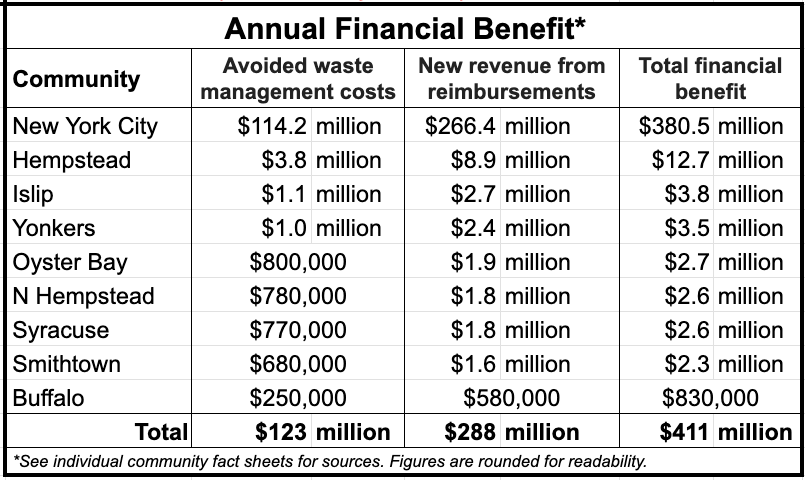
A previous report from Beyond Plastics, "Projected Economic Benefits of the New York Packaging Reduction and Recycling Infrastructure Act," shows how New Yorkers would save $1.3 billion in just one decade after PRRIA becomes law, thanks to the money saved from reducing waste. The new data is an analysis of annual waste reduction savings from a sampling of nine local governments, as well as an estimate of the revenue local governments will make when plastic polluters pay in New York City, Buffalo, Syracuse, Yonkers, Hempstead, North Hempstead, Smithtown, Oyster Bay, and Islip.
Here's how taxpayers will save with PRRIA:
First, PRRIA requires a 30% reduction in single-use packaging, allowing local governments to avoid the cost of collecting 30% of packaging waste, and paying to send it to recycling centers, incinerators, and landfills. Second, businesses selling packaged products will pay a modest fee on packaging that will provide new revenue to local governments to reimburse them for their costs in managing packaging waste, to improve recycling programs and to launch new waste reduction programs such as reuse and refill. Reducing waste is cheaper than recycling, composting, landfilling, or incineration.
As the attached table shows, an estimated $411 million in annual financial benefits - avoided waste management costs (savings) and revenue from reimbursements - will be realized by just nine selected communities when the law is fully implemented.
See the fact sheets breaking down cost savings in each of these communities:
"The City of Albany's Rapp Road landfill is projected to close in 2028, and taxpayers will be left paying more to manage and dispose of our waste. To control these costs, we must reduce the amount of waste we generate at the source. The Packaging Reduction and Recycling Infrastructure Act is an important first step, and the State Legislature should pass it this legislative session. We don't have another year to wait," said Sam Fein, Albany Chief City Auditor.
"New York State is in a solid waste crisis. Landfill capacity is decreasing, and the fossil fuel industry is ramping up plastic production. The Ulster County Resource Recovery Agency disposes of roughly 100,000 tons of municipal solid waste (MSW) to in-state landfills each year. 16,000 tons of that MSW is unrecycled plastic. The 30 percent reduction in packaging alone would save the Agency, and Ulster County residents, at least $540,00 dollars every year. I call on the Assembly to follow the Senate's lead and pass PRRIA now," said Marc Rider, Executive Director, Ulster County Resource Recovery Agency.
"The Packaging Reduction and Recycling Infrastructure Act could slash recycling and waste disposal costs across the state by more than half! With the legislature laser-focused on affordability, PRRIA is one of the most consequential bills the Assembly must pass this year. Seventy-three percent of New York voters support the legislation, and more than half of the Assembly co-sponsors the bill. It's already on the Assembly floor since it passed in all four committees in 2025. We respectfully call on Speaker Heastie to bring the bill up for a vote," said Judith Enck, former EPA regional administrator, president of Beyond Plastics, and co-author of the new book "The Problem with Plastic."
"It's been more than two years since the DEC issued its comprehensive plan to attack New York's worsening trash disposal crisis. In their report, they stated that landfills are filling to capacity and disposal permits are expiring. The DEC specifically called for producer responsibility legislation to curb NY's growing mountain of trash. This legislation is an important component of that plan. The Assembly must act now, or this crisis will continue to get worse," said Blair Horner, NYPIRG senior policy advisor.
BACKGROUND
The Packaging Reduction and Recycling Infrastructure Act (S1464 Harckham/A1749 Glick) will transform the way our goods are packaged. It will dramatically reduce waste and ease the burden on taxpayers by making companies, not consumers, cover the cost of managing packaging. The bill will:
- Reduce plastic packaging by 30% incrementally over 12 years;
- Require all packaging - including plastic, glass, cardboard, paper, and metal - to meet a recycling rate of 75% by 2052 (with incremental benchmarks until then);
- Prohibit the harmful process known as chemical recycling to count toward achieving these recycling rates;
- Prohibit 17 of packaging's worst toxic chemicals and materials, including all PFAS chemicals, polyvinyl chloride (PVC), lead, and mercury;
- Establish a modest fee on packaging paid by product producers, with new revenue going to local taxpayers; and
- Establish a new Office of Inspector General to ensure that companies fully comply with the new law.
A report from Beyond Plastics, "Projected Economic Benefits of the New York Packaging Reduction and Recycling Infrastructure Act," shows how New Yorkers would save $1.3 billion in just one decade after the Packaging Reduction and Recycling Infrastructure Act becomes law. These savings would come from the avoided costs of waste management when there's less waste to manage, and they don't even include the funds that would be brought in after placing a fee on packaging paid by product producers.
This is David versus Goliath. Last year, there were a whopping 106 registered businesses and organizations working against the bill - megacorporations like ExxonMobil, Shell, McDonald's, Amazon, and Coca-Cola. Compare that to the 23 lobbyists working in favor of the bill - mostly nonprofit groups like NYPIRG, NRDC and Food & Water Watch. Read more about the lobbying around PRRIA here.
Megacorporations may be campaigning hard against the bill, but the people want to pass it. A bipartisan 73% of New York voters are in favor of the bill. Because the legislation would save tax dollars and protect our health, over 30 localities across the state have passed resolutions urging Albany leaders to pass it. The New York City Council passed a resolution in support, and the Mayor's Office released a memorandum of support in favor of the legislation. More than 300 organizations and businesses - including Beyond Plastics, Hip Hop Caucus, Hudson River Sloop Clearwater, League of Women Voters, Environmental Advocates, NYPIRG, Earthjustice, Blueland, and DeliverZero - issued a memo of support stating, "This bill would save tax dollars and position New York as a global leader in reducing plastic pollution."
Plastics and Climate
Plastic production is warming the planet four times faster than air travel, and it's only going to get worse with plastic production expected to double in the next 20 years. Plastic products are made from fossil fuels and may contain as many as 16,000 chemicals, many of them known to be harmful to humans and even more untested for their safety. Most plastics are made out of ethane, a byproduct of fracking. In 2020, plastic's climate impacts amounted to the equivalent of nearly 49 million cars on the road, according to a conservative estimate by Material Research L3C. And that's not including the carbon footprint associated with disposing of plastic.
Plastics and Health
Less than 6% of plastic in the United States actually gets recycled. The rest ends up burned at incinerators, buried in landfills, or polluting rivers and the ocean - an estimated 33 billion pounds of plastic enter the ocean every year.
Plastic is being measured everywhere, and microplastics are entering our soil, food, water, and air. Scientists estimate people consume, on average, hundreds of thousands of microplastic particles per year, and these particles have been found in human placenta, breast milk, stool, blood, lungs, and more.
Scientific research continues to find that the microplastics problem is worse than previously thought: New research in the New England Journal of Medicine shows that microplastics are linked to increased heart attacks, strokes and premature deaths. Another study from Columbia University found that bottled water can contain hundreds of thousands of plastic fragments.
Why Chemical Recycling Isn't a Solution
Because plastics recycling is a failure, the plastics and petrochemical industries are now pushing a pseudo-solution: chemical recycling, or "advanced recycling." This is a polluting process that uses high heat or chemicals to turn plastic waste into fossil fuels or feedstocks to produce new plastic products. It's a dangerous distraction that's allowing companies to exponentially increase the amount of plastic - and greenhouse gases - they put into the world. Learn more from Beyond Plastics's report, "Chemical Recycling: A Dangerous Deception." These New York bills do not ban chemical recycling but simply do not allow chemical recycling to count as real recycling.
About Beyond Plastics
Launched in 2019, Beyond Plastics pairs the wisdom and experience of environmental policy experts with the energy and creativity of grassroots advocates to build a vibrant and effective movement to end plastic pollution. Using deep policy and advocacy expertise, Beyond Plastics is building a well-informed, effective movement seeking to achieve the institutional, economic, and societal changes needed to save our planet and ourselves, from the negative health, climate, and environmental impacts for the production, usage, and disposal of plastics.
###
Beyond Plastics
Marissa Solomon, 734-330-0807, marissa@pythiapublic.com


Recent News
- Lawmakers, Advocates Urge Albany To Crack Down on Social Media Scams Costing NYers Billions
- ZOOM: Bronxites to Rally for Stronger Community Protections, As Cross Bronx Expansion Looms
- JCRC-NY Condemns Last Night's Harassing, Intimidating Protest Targeting Jewish Community in Midwood, Brooklyn
- Sweet Truth Act Passes Assembly Health Committee, Next Up Codes Committee
- NEW: SUNNY Act Passes Assembly Energy Committee, Bringing New York One Step Closer To Embracing Solar Power!
- NYS Senate Passes Urgent Fix to CVA and ASA to Ensure Survivors in NY Can Access the Justice They Deserve
- As Governor Hochul Guts Climate Law, 250+ Rally with State Lawmakers: End Plastic Pollution Now
- As Governor Hochul Guts Climate Law, 250+ Will Rally with State Lawmakers: End Plastic Pollution Now
- As Governor Hochul Guts Climate Law, 250+ Will Rally with State Lawmakers: End Plastic Pollution Now
- As Governor Hochul Guts Climate Law, 250+ Will Rally with State Lawmakers: End Plastic Pollution Now
...more

