New York State Cuts $5M for Rape Crisis Centers, Forcing Them to Close or Curtail Services
Providers across the state call on Governor to restore funding ASAP.
Related Media
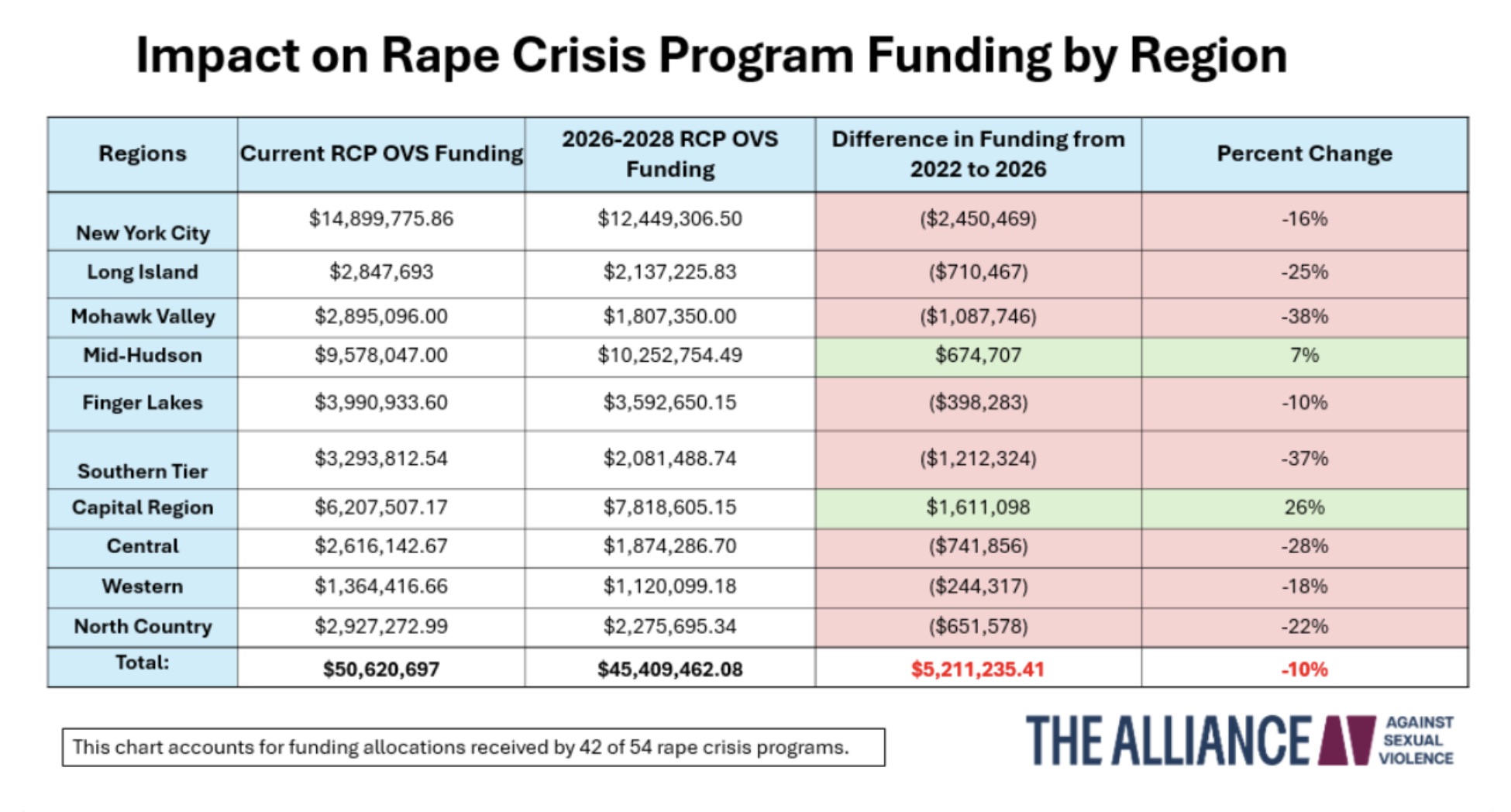
Impact on Rape Crisis Funding By Region
NEW YORK, NY (08/18/2026) (readMedia)-- At a virtual press conference on Tuesday, Rape Crisis Program (RCP) providers, advocates, State Senator Lea Webb, Assemblywoman Catalina Cruz, Assemblymember Linda Rosenthal, and Assemblymember Jeffrey Dinowitz called on Governor Hochul to immediately release funding for these essential services. RCPs are currently on track to lose over $5 million in funding this year from the state's Office of Victim Services. Eight of 10 regions in the state are facing severe funding cuts, making this year the largest constriction of rape crisis programming across New York State in decades-unless the Governor steps in.
WATCH A RECORDING OF THE PRESS CONFERENCE HERE.
Rape Crisis Programs (RCPs) are certified by the New York State Department of Health to train rape crisis counselors, or advocates, to provide free and confidential support to survivors of sexual violence. Certified Rape Crisis Advocates work 24 hours per day, 365 days per year to respond to pediatric and adult survivors both over the phone and in hospital emergency rooms and police precincts. They offer non-duplicated services-24-hour crisis support and hospital accompaniment, trauma informed counseling and support groups; medical advocacy; criminal/legal system navigation; and community outreach and engagement-in communities across the state, serving as the core of New York's sexual violence response workforce.
But right now, according to data from the Alliance Against Sexual Violence, New York's sexual violence coalition comprised of 54 New York RCPs, dozens of RCPs are losing vital grant dollars through the state's Office of Victims Services, which awards federal Victims of Crime Act (VOCA) Victim Assistance Grant Program funding to these programs each year. While more grant funding was allocated in total, that funding was spread across a much larger group of applicants, leaving previously funded surveyed RCPs, many in high-need areas, with far less money. Additionally, a number of culturally specific service providers based in immigrant communities are also facing funding cuts.
While RCPs also receive legislated state funding through the New York State Division of Criminal Justice Services, those funds account for a fraction of VOCA funds that RCPs are eligible for through OVS. The Governor did double the state's RCP funding in the FY25 budget, but that funding was intended to stabilize a sector that hadn't seen a funding increase in over a decade despite an ever-increasing number of survivors coming forward to seek services and a great complexity of cases. VOCA is also the largest source of funding for the state's Domestic Violence programs and Child Advocacy Centers.
Service providers from RCPs discussed the ramifications of these funding cuts for the survivors in the communities they serve. They included:
- Christine Battisti, Executive Director of the Crime Victims Assistance Center (CVAC) in Broome County, which saw a 70% reduction in funding;
- Kellyann Kostyal-Larrier, Executive Director of Fearless, a certified Rape Crisis Program in Sullivan County and domestic violence services provider for Orange and Sullivan Counties, which saw an approximately 30%, reduction in funding;
- Sadie Mahoney, Chief Program Officer at Kingsbridge Heights Community Center (KHCC) in the Bronx, which lost its OVS funding.
- Meredith Ouderkirk, Director of Public Affairs at Planned Parenthood of Central and Western New York, home to the RESTORE program in Monroe, Genesee, Livingston, Wyoming, and Orleans counties, which saw a 49% reduction in funding;
- Kelly Coyne, Chief Program Officer at Safe Horizon, which is facing a $500,000 dollar loss for their five Child Advocacy Centers across the city; and
- Theresa Roth, Executive Director of the New York State Children's Alliance, which is the member organization for the New York State's network of Child Advocacy Centers that have experienced a 31% reduction in funding.
Of the 42 RCPs that responded to the Alliance Against Sexual Violence's survey, 29 will be reducing staff as a result of these decreased funding awards. Chronic underfunding has already made it difficult for RCPs to hire and maintain staff, which 96% of surveyed RCPs confirmed. This is especially true when seeking staff to provide bilingual services. On top of extremely low pay, Rape Crisis Advocates and the larger sexual violence workforce have been excluded from the state's cost of living adjustment increases several years in a row.
Some RCPs are also eliminating free attorney services for survivors; laying off forensic interviewers; eliminating trauma-focused therapy, support groups, and community outreach and prevention programming; closing locations; and halting PREA services for incarcerated survivors at a time when the federal government has already reduced services in carceral settings.
RCPs also partner with local hospitals to provide advocacy services and to conduct training on best practices in working with survivors of sexual violence. As a result of first-of-its-kind legislation that mandates all hospital emergency rooms provide Sexual Assault Forensic Examiners (SAFEs) by 2027, hospitals are reaching out to their local RCPs with increased frequency to access these trainings. A number of RCPs also have SAFE programs, where they provide SAFE examiners directly to local hospitals. Current funding cuts threaten hospitals' ability to comply with this law and the success of legislation that has become a model for states across the country.
In addition to immediate funding increases, speakers also called on Albany to overhaul the way the Victim Assistance Grant Program is administered through the Office of Victims Services' Request For Applications process. The way the grants are awarded makes little sense, failing to ensure that all communities in New York have equal access to survivor services. Speakers also discussed the imperative of having reliable funding streams through the state in order to provide critical social services to survivors. The first step in this process is working with providers and survivors to create a comprehensive and badly needed strategic plan.
"These funding cuts are more than numbers on a spreadsheet. They mean fewer invaluable advocates answering calls, fewer survivors receiving support in hospital emergency rooms, and fewer communities with access to life-saving services. Rape Crisis Programs are the backbone of New York's response to survivors, yet this significant reduction in grant awards to existing providers are pushing many to the breaking point. At least one has to close entirely, leaving an entire county without support. We are calling on Governor Hochul to immediately make up for these losses so every survivor, no matter where they live, can count on receiving the care and support they deserve," said Emily Miles, Executive Director of the The Alliance Against Sexual Violence.
"The cuts to OVS funding will have a real impact on survivors and the services they depend on. The participants we work with are already dealing with so much, and taking away resources can mean fewer services and fewer opportunities for survivors to get the support they need. We must remember that behind these funding decisions are real people whose healing and safety are on the line," said Shaniqua Saxon, Changing Futures Program Director, Kingsbridge Heights Community Center.
"Nearly $7 million in cuts to Child Advocacy Centers will have a very real impact on kids and families across New York. When a child has experienced abuse, they should never be the one to pay the price for an unstable funding system. We owe it to every child to make sure the support they need to feel safe and begin to heal is there when they need it. That's why we are asking Governor Hochul to provide immediate fiscal relief to the CACs facing these cuts and to work with us on a long-term strategy that creates real funding stability for victim services across New York." said Theresa Roth, Executive Director of the New York State Children's Alliance.
"RESTORE is the sole certified Rape Crisis Program serving Monroe, Genesee, Livingston, Wyoming, and Orleans counties, and survivors across our region depend on us for crisis intervention, advocacy, and support. As a nonprofit program, we're used to doing more with less, but a nearly 50% reduction in funding from OVS while demand for services continues to grow in volume and complexity is simply untenable. These cuts will force difficult decisions that no rape crisis program should have to make, potentially affecting staffing, community presence, and access to services. Survivors deserve timely, local support wherever they live, and New York must act now to restore this funding and prevent lasting harm to the state's response to sexual violence," said Michelle Cammarata, Director of RESTORE.
"This is not simply a cut to CVAC-it is a cut to the entire safety net surrounding survivors of crime in our community. Every advocate we lose, every service we have to reduce, and every program we are forced to scale back creates a ripple effect across the agencies that depend on us and that we depend on: law enforcement, hospitals, prosecutors, child advocacy centers, schools, colleges, and community partners. We have spent decades building a coordinated system so that when a survivor reaches out for help, they do not have to navigate trauma alone. When that system is weakened, the consequences are not measured in budget lines-they are measured in children who may go without support, survivors who may wait longer for help, families who may fall through the cracks, and communities that become less safe. Funding victim services is not funding an agency; it is funding the network that protects people when they are at their most vulnerable," said Christine Battisti, Executive Director of the Crime Victims Assistance Center (CVAC).
"Safety is a human right, that is the baseline for every survivor, not a benefit that some receive and others have to fight for. We implore Governor Hochul and the Office of Victim Services (OVS) to restore this critical funding for every single community in New York State to have access to lifesaving services. The safety of survivors is paramount and they need to know they are supported and are not alone in their most crucial time of need," said Kelly Coyne, Chief Program Officer, Safe Horizon.
"These services are not isolated programs operating in silos. They are part of an integrated continuum of care built on shared expertise, coordinated infrastructure, cross-trained advocates, and longstanding collaborative partnerships to ensure that victims receive timely, seamless, and comprehensive support-regardless of how or where they enter our system. As a result, a funding reduction of this magnitude cannot be absorbed by a single program or funding source. It will inevitably weaken the entire service delivery system across multiple programs, resulting in reduced staffing, diminished capacity, and fewer available services. The impact extends beyond Fearless!. It will also disrupt the coordinated network of community partners-including law enforcement, prosecutors, healthcare providers, and fellow victim service organizations-that rely on our expertise and infrastructure. The collaborative systems that make this work possible have been built through decades of shared commitment. They cannot be quickly or easily replaced. We need the Governor to step in to ensure the continuity, quality, and accessibility of services for victims throughout the region," said Kellyann Kostyal-Larrier, Executive Director of Fearless!.
"As a survivor myself, I know how critical these programs are for providing survivors in crisis with essential services they may not be able to access elsewhere. This is particularly true in high-needs communities and for survivors facing multiple barriers to care, including language barriers. We must ensure that every survivor, regardless of who they are or where they live, can equitably access the full range of services provided by Rape Crisis Programs and other victim support programs. I strongly urge the Governor to fill this funding gap," said Assemblywoman Catalina Cruz.
"This massive cut in funding will force rape crisis centers like the Kingsbridge Heights Community Center in my district to lay off staff, reduce services, and scale back their operations in the community," said Assemblyman Jeffrey Dinowitz. "Despite being the only rape crisis center serving the Bronx, adequate funding to maintain and expand operations was not secured. Across every corner of New York, survivors will feel the devastating consequences of these centers being denied the resources they need to serve their communities. New York State must do everything in its power to ensure this vulnerable population is supported and that the dedicated staff at these centers have the resources they desperately need to continue their critical mission."
"The need for crime victim services is growing at a time when resources are becoming more scarce. We were surprised to learn that highly successful programs run by agencies like the Crime Victims Assistance Center (CVAC) in Binghamton, had sustained devastating funding cuts in the last round. We had no idea that the recent competitive grant process could jeopardize anchor institutions like CVAC, and others like it across the state. We are calling upon the Governor to fill this desperately needed funding gap before rape crisis and other programs are dismantled and workers are laid off. This will provide time for this matter to be reviewed in the context of next year's budget," said Assemblymember Donna Lupardo.
"New York's rape crisis programs provide critical services to survivors at some of the darkest moments in their lives," said Assemblymember Linda B. Rosenthal (D/WF - Manhattan), Chair of the Assembly Housing Committee. "Many of these programs have been doing this work for decades, but were recently notified of drastic funding cuts that will leave them no choice but to lay off staff, reduce services or even shut their doors entirely. Rape crisis programs cannot meet the needs of the communities they serve if their funding continues to be calculated through an opaque and inconsistent formula. New York State must prioritize the needs of survivors by immediately closing this funding gap and working to overhaul the OVS grant process, ensuring that providers receive funding based on their individual needs."
"When a survivor reaches out for help, there must be someone there to answer the call. These cuts threaten the services that survivors and their families rely on in some of the most difficult moments of their lives. New York must act now to ensure that no survivor is left without support," said Assembly Member Amy Paulin.
"The unexpected and unreasonable cuts to Crime Victim Assistance Centers like Dutchess County's Family Services in my Assembly District will have devastating consequences for crime victims and survivors across New York State," said Assemblymember Didi Barrett. "These services are a lifeline for many of my Hudson Valley constituents, especially those in rural communities without other service providers or public transportation. I stand with my colleagues and advocates from across the state in urging the Office of Victims Services to restore the funding cuts to protect New Yorkers and their families," said Assemblymember Didi Barrett.
"Steady, reliable financial support for survivors of domestic violence - and the organizations they rely on - saves lives. When we talk about public safety, providing resources for crisis survivors must be part of that conversation. The inexplicable cuts advanced by the Office of Victim Services are flat-out dangerous and need to be immediately reversed to ensure uninterrupted services for vulnerable New Yorkers," said State Senator James Skoufis.
"Gender based violence rates are continuing to rise at alarming rates, especially in New York and the region I represent in the Southern Tier," said Senator Lea Webb. "We have great advocates and workers who are addressing these and other public safety challenges in our community in numerous and irreplaceable ways. To say the funding cuts from the Office of Victims Services are devastating is an understatement. Rape Crisis Advocates and the larger violence prevention workforce are dedicated to supporting survivors through extreme hardship, and they were already severely under-funded. I stand with my colleagues in the State legislature and advocates from throughout the state to highlight this issue and hope that the Governor can facilitate restoring funding for these critical public safety services."
The Alliance Against Sexual Violence
jessica@pythiapublic.com


Recent News
- IMPACCT BK Statement on COPA: "A Real Tool For Nonprofits to Help Solve the Housing Crisis"
- IMPACCT BK Statement on COPA: "A Real Tool For Nonprofits to Help Solve the Housing Crisis"
- Hudson Valley Leaders Tell Governor Hochul: Legalize Plug-In Solar!
- Statement from JCRC-NY CEO Mark Treyger on Democracy and Civic Engagement Ahead of Early Voting in New York
- This DV Awareness Month, NY DV Programs and Lawmakers Sound Alarm on Funding Crisis and Urge State to Step In
- Broad Coalition Of Advocates Rally To "Get Out The Early Vote" Ahead Of Early Voting Start
- AG James, Voting Rights Groups Get Out the Early Vote
- During Domestic Violence Awareness Month, NY Programs Sound the Alarm on Crisis Threatening Survivor Services
- Broad Coalition Of Advocates Rally To "Get Out The Early Vote" Ahead Of Early Voting Start
- AG James, Voting Rights Groups Get Out the Early Vote
...more