SUNY Cortland Anthropologist Continues Turkish Excavations
Related Media
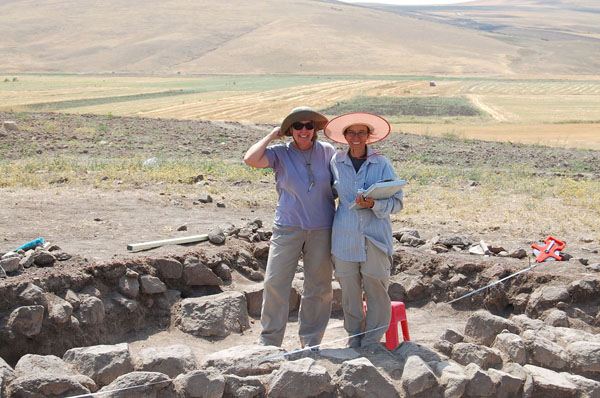
Sharon Steadman, left, and Ana Gabriela Castro Gessner, both from SUNY Cortland’s Sociology and Anthropology Department, pose at the excavation site at Çadir Höyük, Turkey.
CORTLAND, NY (04/16/2009)(readMedia)-- Almost every summer for the past 16 years SUNY Cortland anthropologist Sharon Steadman and a core team of excavators start their long days at 4:15 a.m. in Peyniryemez, Central Turkey, where they search for puzzle pieces of a culture that dates back to 5200 B.C.
Steadman, a faculty member in SUNY Cortland's Sociology and Anthropology Department, and a dozen students and local villagers dig at the nearby archaeological site in an area called Çadir Höyük, which means "tent mound."
The workers use hand picks, pointed trowels, shovels, wheelbarrows, brushes, scalpels and digital cameras, among other tools, to uncover and document this ancient culture. Last year, they added a magnetometer, a device that detects sub-surface architecture, without actually uncovering it.
"The magnetometer was helpful," Steadman explained. "We found a couple of strangely shaped structures that we think might be a corral, cistern or well. We hope to begin uncovering that area this summer to learn more."
The explorers, who take a second breakfast at 9 a.m., finish their day in the field at 1:30 p.m., when the temperature can reach a scorching 110 degrees Fahrenheit. The crew spends the late afternoon processing their day's finds in the laboratory.
"We will work Saturday through Wednesday, and take Thursdays off for a market day in the village," said Steadman. "Fridays end at noon in observance of the Muslim holy day."
Although the work schedule can be exhausting, Çadir Höyük holds a special attraction for Steadman, who has served as the project's field director since 1998.
"There are two main reasons why I keep coming back," Steadman explained. "I love the village, it's like my second home. The people who live there and the group that I work and live with are some of my closest friends and are like family.
"It is also the excitement of discovery and what's lying there under the surface," she added. "I like what it tells us about the past and what the local villagers are teaching us about modern Turkish life."
The multi-period site of approximately 50 acres has also influenced Steadman's classroom content back at SUNY Cortland.
"My work in Turkey has been an incredible resource in gender studies, culture studies and has given me first-hand information to impart to my students while bringing Middle Eastern people to life," explains Steadman, who serves as the group's expert on the Chalcolithic Period, which encompasses 5000-3000 B.C.
The past three years of the excavations have been primarily focused on the Byzantine era, which extends back to as early as the sixth century A.D. at Çadir Höyük, because the majority of the funds secured were for work in that specific time period.
"We have uncovered and learned a lot about this rural area," said Steadman, noting that the earliest Byzantine excavations have revealed materials from the sixth or seventh century A.D. up to the 11th century.
Marica Cassis, an assistant professor in the Department of History at Memorial University in Newfoundland, Canada, has been the group's Byzantine expert since 2002, when they began to uncover more artifacts from that era and needed someone with extensive knowledge of that time period.
"Part of the problem with Byzantine archeology is that it has mainly concentrated on big monuments, like churches and palaces in cities," said Cassis, a former assistant professor of history at SUNY Cortland. "Very little work has been done out in the countryside. The majority of people lived in the country, but very little is known about what they were doing.
"We've excavated a farmhouse and we are learning a lot about an ordinary Byzantine village. "As a historian you can really get a glimpse of what daily life really looked like for these people. I love the ability to see what an ordinary person might have been doing."
Their discoveries reveal a farmhouse with a communal kitchen as well as big, spacious rooms, and point to extended families that lived together and not in individual, smaller homes.
This past summer the projects, "The Byzantine Period at Çadir Höyük: a Rural Community in the Byzantine Hindterland," and "Çadir Höyük: An Agricultural Community on the Anatolian Plateau," were supported by Steadman and Cassis's third $10,000 grant from the Dumbarton Oaks Research Library and Collection, an international research center affiliated with Harvard University.
Steadman and Cassis, who serve as co-principal investigators on both awards, received an additional $27,250 for the project in March 2008 from The Loeb Classical Library Foundation in Cambridge, Mass., which also is closely affiliated with Harvard University.
"Through our continued and expanded excavation we hope to draw firmer conclusions regarding the nature of the people who occupied the site during the 11th Century," said Steadman, who has worked on other projects in Turkey, Jordan, Cyprus and Israel. "We also are pursuing evidence to help better define the specific purpose of the large domestic, rural complex we previously unearthed.
"Çadir Höyük is such a large, rich site that we could easily work for another 50 years and just scratch the surface. We are making huge contributions to all periods and as long as we continue to have funding, I can foresee us working through the year 2020."
A research anthropologist, Steadman is an authority on architecture and landscape archaeology, archaeology of religion, and prehistoric economics systems and interactions analysis. She co-directed Shamkir Valley and Castle Survey Excavations in Azerbaijan.
Steadman's work on Chalcolithic digs in Turkey has been supported by 14 other grants. In 2007, the Research Foundation of SUNY honored Steadman among 30 of its most important and innovative scholars and scientists. In 2004, the State University of New York awarded her with its Chancellor's Award for Excellence in Teaching.
The author of more than 13 articles and four reviews, Steadman has presented at major conferences. Her book, The Archaeology of Religion: Cultures and Their Beliefs in Worldwide Context, will be available this spring. She is a member of the honor society for all academic disciplines, Phi Kappa Phi.
Steadman coordinates the College's International Studies Program and directs the Rozanne M. Brooks Museum, an ethnographic teaching museum on campus.
She lives in Lansing, N.Y., with her husband, SUNY Cortland Associate Professor and Chair of History Girish Bhat. She earned her bachelor's degree at the University of California at Santa Barbara and her master's and doctoral degrees at the University of California at Berkeley.
Cassis, who has played a part in excavations in Tunisia and other sites in Turkey, is the author of several articles, book reviews and encyclopedia articles. She is a member of the American Schools of Oriental Research, Byzantine Studies Association of North America and the Canadian Society for Syriac Studies.
She received her bachelor's degree at the University of Alberta and her master's and doctoral degrees from the University of Toronto in Canada.
-30-


Recent News
- Fall 2025 Part-time Student Awards announced
- Fall 2025 President's List honors students
- SUNY Cortland announces its Fall 2025 Dean's List
- Spring 2025 Part-time Student Award for Academic Achievement honorees announced
- SUNY Cortland announces its Spring 2025 Dean's List
- SUNY Cortland announces Spring 2025 President's List
- Fellowships encourage summer research
- Students place among best in state business competition
- Banquet celebrates student leaders
- Green Reps take evironmental action
...more