

As Cross Bronx Expansion Looms, Bronxites Rally for Stronger Community Protections
With a Cross Bronx expansion on the horizon, community members and advocates urge the Governor to beef up mitigation measures and protect the South Bronx with more significant investments in the project area
Related Media
2f510721-1.png
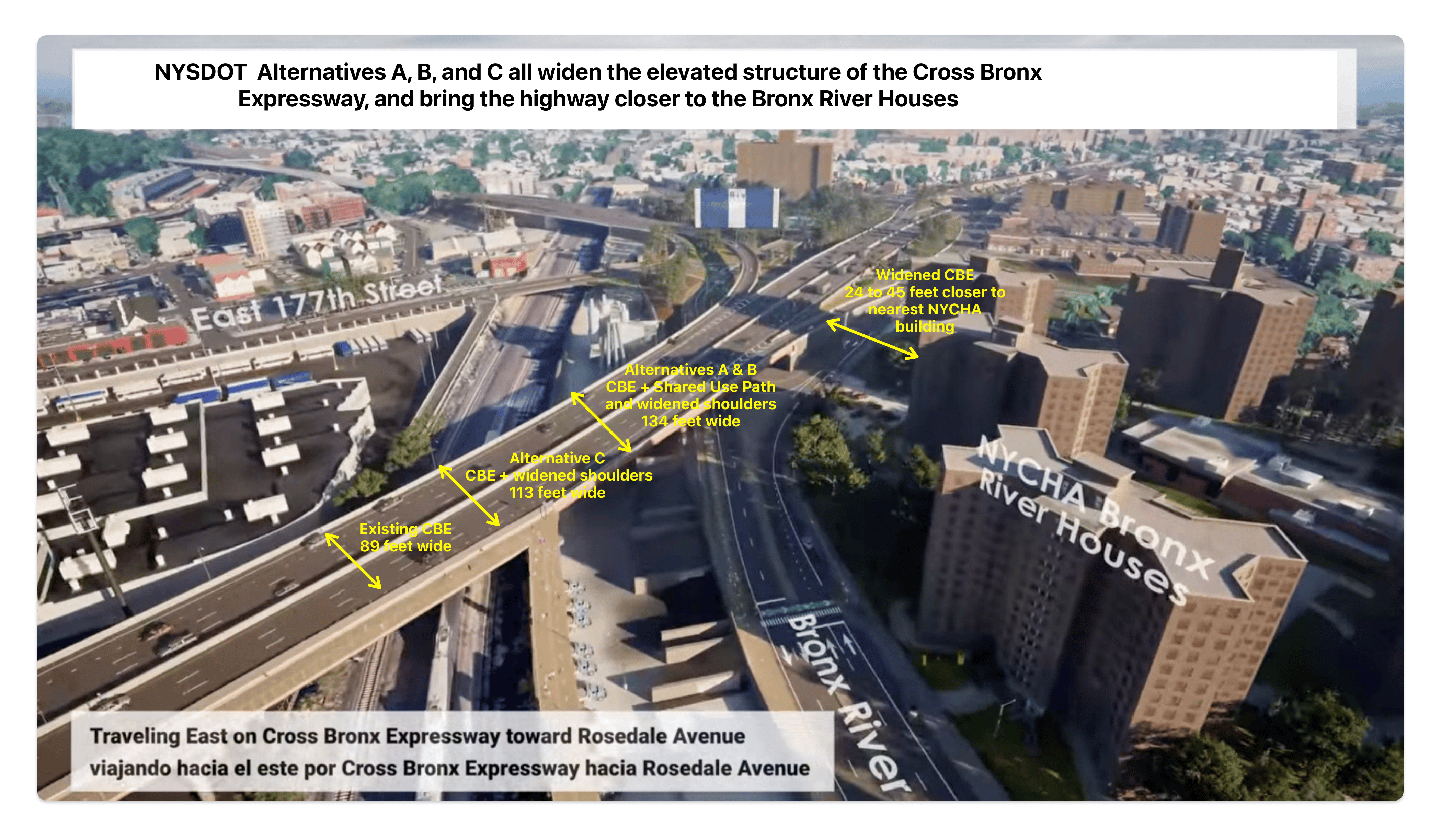
BRONX, NY (05/14/2026) (readMedia)-- Today, local residents, community groups, and members of the Stop the Cross Bronx Expansion joined the Bronx River Alliance at a virtual press conference urging Governor Hochul to halt the planned expansion and meet their demands for stronger South Bronx investment. Despite the dangers, the State Department of Transportation is moving forward with plans to expand the Cross Bronx by up to 50 feet, pushing it closer to 3,000 public housing residents at Bronx River Houses currently battling high asthma rates.
View a recording of the press conference here and a rendering of the proposed expansion below.
A bigger Cross Bronx threatens 64,000-plus local residents living along the project site with severe health consequences for at least the next 80 years - at a time when South Bronx communities are already experiencing worse air quality as a result of congestion pricing. As the city's only remaining major freshwater river, the Bronx River is also directly in the path of an expanded expressway officials acknowledge will increase pollution and stormwater runoff.
"The clock is running out. More than 64,000 South Bronx residents live in the shadow of the Cross Bronx. While we remain in active conversations with the state, officials are still avoiding the hard commitments our communities need most. Expanding the highway will only lock in a future where ER visits keep climbing and local air quality keeps deteriorating. As the extended deadline nears, Governor Hochul must prioritize stronger investments that protect the health, safety, and future of every resident along this corridor. It's now or never," said Siddhartha Sánchez, Executive Director of the Bronx River Alliance.
"Bronx residents have lived with the health consequences of highway pollution for generations, and communities already facing some of the highest asthma rates in the country should not be asked to carry even more of that burden. As pollution concerns continue to grow, any plan affecting the Cross Bronx must put public health, clean air, and meaningful community protections first. The Bronx deserves investments that repair past harms, not decisions that risk deepening them," said Senator Nathalia Fernandez.
"At Bronx River Houses, every single part of our life is shaped by what it means to live next to the Cross Bronx. None of our families can open our windows without risking our health, and now the state wants to bring the highway even closer to our doorstep. A bigger Cross Bronx is a trap for our communities. It means more traffic, more fumes, and more trips to the ER to manage my daughter's asthma. We need Governor Hochul to stop the expansion, protect our families, and invest in the South Bronx," said Tiffane Thorpe, resident at Bronx River Houses.
"For decades, the Cross Bronx Expressway has harmed Bronx communities with pollution, traffic violence, flooding, and disinvestment-and Bronx residents have made clear they will not accept another generation of harm. Transportation Alternatives stands with the Stop the Cross Bronx Expansion Coalition in demanding real reparations: investments in clean air, safe streets, public transit, parks, and protected bike and bus infrastructure that put community health and dignity first," said Anna Berlanga, Bronx/Uptown Organizer for Transportation Alternatives.
"Expanding the notorious Cross Bronx Expressway is such an obvious wrong that, if the state chooses this path, Governor Hochul must remedy it with an unprecedented set of investments in the community, local transit options, and public health. The governor needs to find a way to stop the harms and heal the wounds of children and elders just as if she had decided to decommission the looming structure and reconnect the surrounding neighborhoods. If Bronx families are truly, as the governor says, her fight, she must come to the table like no state leader before her," said Riders Alliance Policy & Communications Director Danny Pearlstein.
"For decades, highway policies have burdened Bronx communities. It started with the Cross Bronx and the displacement of tens of thousands of people. Then came the disproportionate pollution, noise, and health consequences. We're calling on Governor Kathy Hochul and NYSDOT to halt their expansion plans, and instead, invest in public transit, sustainable infrastructure, and the environmental justice efforts that Bronx residents need and deserve," said Edmundo Martinez, Co-founder of Concrete Friends.
"At Patagonia, we talk a lot about repair. We say, 'If it's broke, fix it'-and that includes the systems people rely on every day. But repair means doing no unnecessary harm in the process. Expanding the Cross Bronx Expressway doesn't fix anything; it risks increasing pollution by 33% in neighborhoods already burdened by pollution and asthma. The path forward isn't complicated: repair the highway, don't widen it. We're calling on Governor Hochul to invest in South Bronx communities, and make decisions that support long?term health over short?term traffic flow," said Leticia de Mello Bueno, Activism Lead, Patagonia.
The coalition continues to push for clean air and water, stronger transit, improvements to the NYCHA Bronx River Houses development, and improved neighborhood infrastructure, among other community priorities outlined in the Reimagine the Cross Bronx study:
- Launch a community advisory council to enhance collaboration and community-centered planning around the Reimagine the Cross Bronx vision, ensuring accountability for the implementation of the vision along the corridor.
- Increased investment in community programming ($30M) directly supporting local groups within the project area. Focus areas include:
- Environmental stewardship, environmental education, and programming that increases high quality access to nature for Bronx residents and youth. Examples include dedicated internships, field trips, stewardship opportunities, and access to guided outdoor activities.
- Green workforce development programs and apprenticeships to support Bronx residents and youth in securing jobs, pursuing careers, and launching businesses to advance environmental justice, sustainability, and climate resiliency.
- Expanding community health initiatives such as the Bronx Asthma Initiative.
- Protect and transform E 177 Street into a green corridor ($75-$150M): Fund the redesign of E 177 St to prevent traffic from re-clogging the street, including green infrastructure, pedestrian and bike safety features.
- Invest in non-highway modes of transportation ($20M) to benefit local residents, through surface transit, train accessibility, and Blue Highways freight infrastructure.
- Support planning for a street-level protected east-west bike path across the Bronx through collaboration with relevant city agencies and stakeholders.
BACKGROUND
The New York State Department of Transportation is currently proposing the Cross Bronx "5 Bridges Project," a $900-million plan (including $150 million of federal funding for reconnecting communities harmed by highways) that threatens to exacerbate environmental inequities facing the South Bronx. Despite heeding community concerns and scrapping four of its most noxious plans - including a new mile-long polluting roadway - Governor Hochul and NYSDOT are not reducing traffic and are still proposing expanding the Cross Bronx by 50 feet.
The Stop the Cross Bronx Expansion Coalition is urging NYSDOT and Governor Hochul to conduct the needed standard bridge repair without expanding the highway, and work with community members toward more equitable, environmentally just traffic and air quality solutions for the corridor.
Why Expanding the Cross Bronx Isn't Viable
The Cross Bronx's enormous environmental footprint has only worsened over the years. In the U.S., fossil fuel-powered vehicles are a major source of air pollution and heat-trapping emissions, releasing more than 50% of the nitrogen oxide found in our air. Nearly 150,000 vehicles, including 18,000 trucks, use the Cross Bronx daily. State DOT's environmental assessment notes that during peak times, heavy truck traffic could increase by as much as 33% if the agency proceeds with an expansion.
In 2022, NYSDOT illegally dumped pieces of the roadway directly into the Bronx River after demolishing a Cross Bronx entrance ramp during a similar rehabilitation project. Even if the state files permits, local residents are still concerned that DOT's project may similarly impact the river, under the current "5 Bridges" project. Thanks to sustained remediation efforts, wildlife has slowly returned to the river following the incident, including threatened birds such as herons and even dolphins. But during ongoing river clean-ups with local volunteers, residents continue to find construction waste tossed from the expressway into the recovering waterway. State DOT's remaining plan threatens to reverse this hard-won progress and drive worsened air quality, increased pollution, and more chronic illness in an already overburdened community.
Community Alternatives for the Cross Bronx
Since the 1970s, community members have long advocated for investment in safe, dignified, and simple improvements for South Bronx neighborhoods. After years of grassroots organizing to expand and transform the former industrial site into a vital community resource, Starlight Park has recently doubled in size; the state-proposed expansion now threatens this precious parkland. Meanwhile, existing east-west corridors along the Cross Bronx, including some of its most dangerous intersections on 174th Street, 177th Street, and East Tremont Avenue have been ignored and neglected for decades.
In 2014, City Council awarded NYCDOT the funds to create signalized crossings at five intersections around E 177th St. and E Tremont Ave. Over a decade later, the project still hasn't been completed, depriving local residents of accessible pathways. The state's planned expansion ignores the rest of E 177th St and other proposed connections along the highway, in a departure from residents' top priorities. As outlined in the community's visioning process for the Cross Bronx, Bronxites are seeking alternatives that reduce traffic, restore community access to green space, and reconnect riverside neighborhoods along the expressway.
About Bronx River Alliance: The Bronx River Alliance serves as a coordinated voice for the river and works in harmonious partnership to protect, improve and restore the Bronx River corridor so that it can be a healthy ecological, recreational, educational and economic resource for the communities through which the river flows.
About the Stop the Cross Bronx Expansion Coalition: The Stop the Cross Bronx Expansion coalition is composed of Bronx grassroots groups, environmental justice organizations, and advocates for safe and healthy transportation. Together, we are fighting to implement a positive community-led vision that reverses the harms done to the public health, environment, and social and economic life of the Bronx by the Expressway. To realize this vision requires stopping new highway expansions along the Cross Bronx – beginning with New York State DOT's current plan to widen the CBE.
###
Bronx River Alliance
Adaku Nwokiwu, 347-455-8121, adaku@pythiapublic.com


Recent News
- Election and Voting Rights Experts Hold Briefing On What To Expect Ahead of Early Voting
- Election and Voting Rights Experts Hold Briefing On What To Expect Ahead of Early Voting
- After Trump Speech, Groups and Electeds Reaffirm Fracking Ban and Stopping Constitution Pipeline
- NYC Hotels Back City Council Resolution as Trade War With Canada Drives Top Tourism Partner Away
- Trump Visits NY As He Tramples on States' Rights, Tries to Force Fracked Gas Pipeline & AI Data Centers on NY
- Advocates + Survivors Demand Action from NY, Lay Out Comprehensive Bill Package in Response to Cornell Crisis
- Advocates + Survivors Demand Action from NY, Lay Out Comprehensive Bill Package in Response to Cornell Crisis
- Advocates + Survivors Demand Action from NY, Lay Out Comprehensive Bill Package in Response to Cornell Crisis
- JCRC-NY Responds to Mayor Mamdani's Statement on the Third Anniversary of the October 7 Attack on Israel
- Advocates + Survivors Demand Action from NY, Lay Out Comprehensive Bill Package in Response to Cornell Crisis
...more

