

Unified Area Command: Agencies Joining Together to Fight the Floods
Story by Staff Sgt. Robert Fafoglia, 139th Mobile Public Affairs Detachment
Related Media
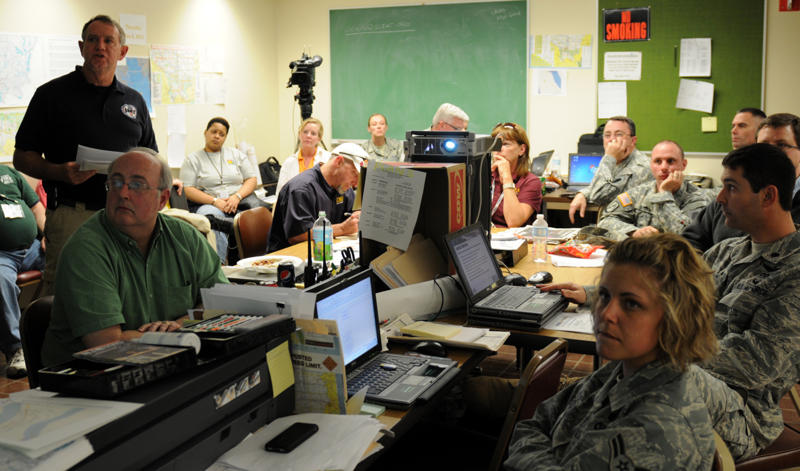
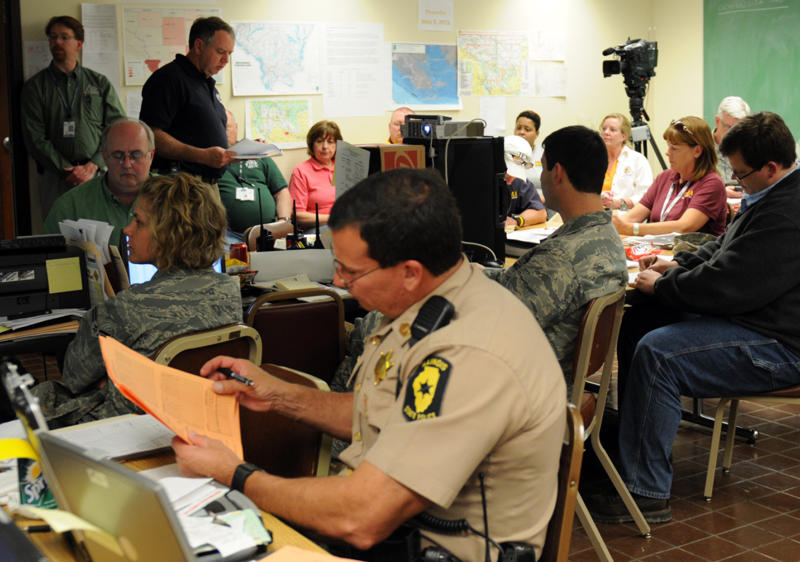
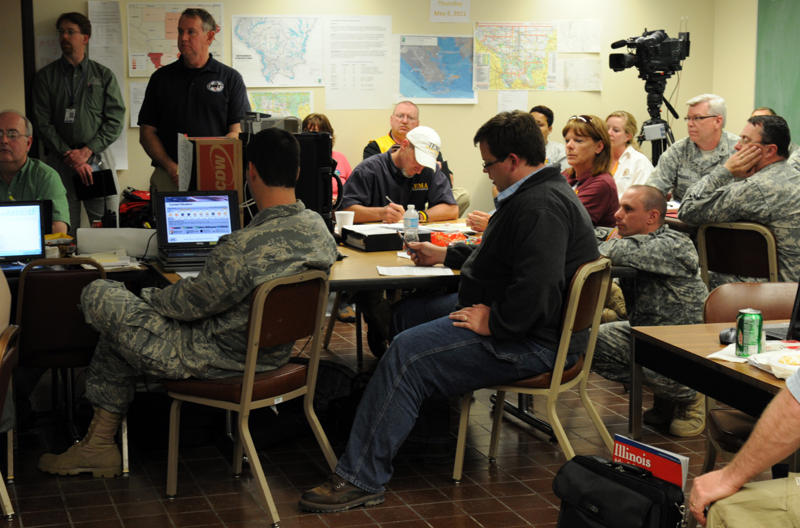
Representatives from state, federal and non-governmental agencies meet at the Unified Area Command May 6 in Marion, to receive a situational update brief on the flooding in southern Illinois.
-
 Representatives from state, federal and non-governmental agencies meet at the Unified Area Command May 6 in Marion, to receive a situational update brief on the flooding in southern Illinois.
-
 The Illinois Emergency Management Agency has operated the UAC 24 hours a day, allocating resources and personnel for assistance requests from county and municipal agencies to protect lives.
MARION, IL (05/08/2011)(readMedia)-- When disaster strikes, the Illinois National Guard often plays a pivotal role in emergency response. The recent flooding in southern Illinois is no different. It does, however, take the joint effort of many agencies to protect lives, property and critical infrastructure.
During an emergency situation, the Illinois Emergency Management Agency coordinates state, federal and non-governmental agencies, in order to support municipal and county agencies with relief operations. These agencies provide representatives that offer logistical and operational support in their respective areas of expertise. This pooling of agencies meets under one roof, the Unified Area Command.
"They deployed several of us to augment and integrate into IEMA's incident management team," said Air Force Lt. Col. Chuck Coderko of Springfield, the operations section chief for the Joint Task Force, which is comprised of the 183rd Fighter Wing and the 65th Troop Command Brigade both based in Springfield. "This was to make sure we had planners, logisticians and operations people on the incident management team, to help with all forces from all agencies. It is very much a joint effort."
The UAC was established at the Illinois Regional Office in Marion on April 25, and has operated 24 hours a day allocating resources and personnel for assistance requests from state, county and municipal agencies.
Army Capt. Jennifer Fallert of Effingham, a logistics liaison officer with Joint Force Headquarters in Springfield, acted as a liaison for Illinois National Guard servicemembers on equipment required for flood operations, as well as supplies from all civilian and military personnel.
She also provided logistical support to the civilian emergency managers from 11 different counties in Southern Illinois. Fallert said the experience was eye-opening.
"This mission was a tremendous opportunity to increase my knowledge of the multitude of support agencies, their assets and capabilities, and be a part of a team that provides immediate support to communities in dire need of support," she said.
Fallert said it took the combined effort of the UAC to provide support to southern Illinois.
"Inter-agency support was integral to this mission," she said.
Coderko agreed wholeheartedly.
"It's really become a joint team," said Coderko. "I think there's been a lot of synergy working with the civilian side. The joint task force and a lot of folks on the Air and Army side are trained on NIMS, the National Incident Management System. We all speak the same language now."
Walt Lewis, IEMA's satellite communications manager for the bureau of operations, said this was his first disaster response that included direct contact with the Illinois National Guard.
"There is a definite spirit of cooperation," he said. "In general, the response and working relationships have been great. I had an opportunity to work with some folks from the Guard. They've been real helpful, and I'm very appreciative of them."
Overall, Coderko said he was pleased with the results of the joint task force.
"The Army, Air and civilians are working hand-in-hand," he said. "I think we've integrated very well."
photo (all) Photo by Staff Sgt. Robert Fafoglia, 139th Mobile Public Affairs Detachment/ Representatives from state, federal and non-governmental agencies meet at the Unified Area Command May 6 in Marion, to receive a situational update brief on the flooding in southern Illinois. The Illinois Emergency Management Agency has operated the UAC 24 hours a day, allocating resources and personnel for assistance requests from county and municipal agencies to protect lives, property and critical infrastructure.


Recent News
- CHRISTMAS AT THE FRONT
- Naperville Native promoted to Major
- Chatham Soldier Promoted to Sergeant First Class
- Specialized Illinois National Guard Unit Mobilizes for Afghanistan
- MEDIA ADVISORY: Illinois National Guard Team Mobilizes for Afghanistan
- Illinois Ready: Prairie Assurance Exercise 2018
- ILLINOIS NATIONAL GUARD CONDUCTS MAJOR EARTHQUAKE EXERCISE
- Decatur Soldier recognized for achievement
- Berwyn Soldier Promoted to Specialist
- Chicago-based Illinois National Guard unit mobilizes for Iraq
...more

