Award-winning Novelist Darryl Pinckney to Read from his Work December 5, 2007
NYS Writers Institute Events Weeks of December 3 - 14, 2007
Related Media
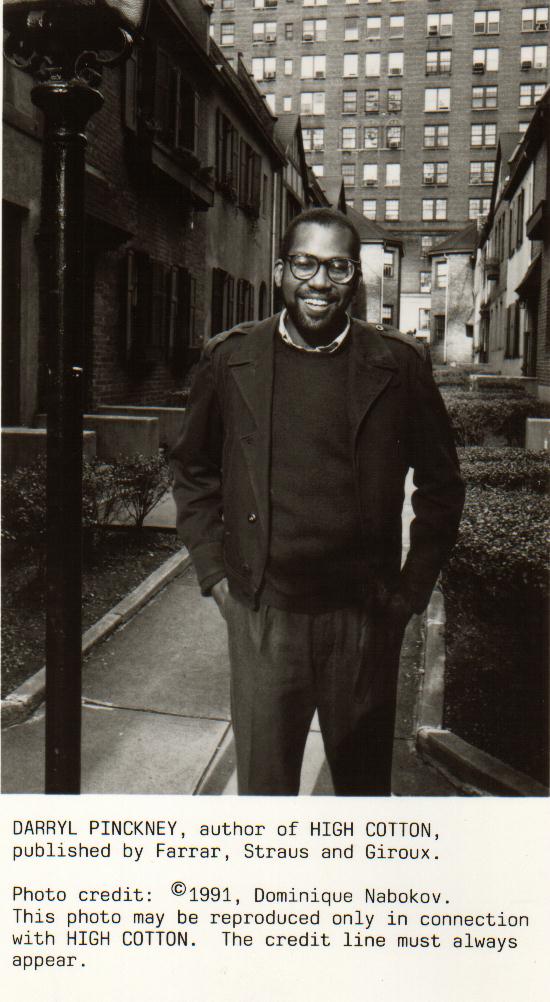
Award-winning Novelist Darryl Pinckney
ALBANY, NY (11/15/2007)(readMedia)-- Darryl Pinckney, Author of Classic Autobiographical Novel of Middle Class Black Experience, “High Cotton,” to Read December 5, 2007
Darryl Pinckney, author of the classic of Black autobiographical fiction, “High Cotton” (1992), which received the “Los Angeles Times” Book Prize, and of several works of literary criticism about African American authors, will speak Wednesday, December 5, 2007 at 8:00 p.m. in the Recital Hall, Performing Arts Center, on the University at Albany’s uptown campus. Earlier that same day at 4:15 p.m. the author will present an informal seminar in Science Library 340 on the uptown campus. The events are sponsored by the New York State Writers Institute, and are free and open to the public.
Darryl Pinckney, prize-winning novelist, playwright, and essayist is best-known for “High Cotton” (1992), his semi-autobiographical satirical novel about growing up Black and bourgeois in America in the 1960s. The book explores a sheltered, educated Black man’s encounters with the world of White society, as well as his participation in the Civil Rights Movement and his complicated love-hate relationship with Black Nationalism.
“High Cotton” received the “Los Angeles Times Book Prize” for fiction. The “New York Review of Books” praised the novel for “delicately, intelligently tracing pieces of an uninvented life. The art is in the selection of the traces and in the angle of vision.” The reviewer, Michael Wood, also said, “Pinckney’s prose—funny, observant, lyrical, self-deprecating—is as good as any now being written in English.”
Pinckney is the author most recently of “Out There: Mavericks of Black Literature” (2002), critical and biographical sketches of three Black authors who lived and worked in Europe: J. A. Rogers, Vincent O. Carter, and Caryl Phillips. “World Literature Today” said the essays, “are eminently readable and flow beautifully.... [Pinckney] is incisive, his touch light but full of conviction.”
He is also the author of a recent essay on the life of Olaudah Equiano, an African ex-slave who campaigned for the abolition of slavery in the British Empire in the 18th century. The essay appears in “William Blake and Slavery: Mind-forg’d Manacles” (David Bindman, July 2007), a volume that explores Blake’s keenly felt response to the evils of physical slavery, and his extensive use of slavery as a metaphor for the modern condition of the 18th and 19th centuries.
Pinckney’s other works include the collection of critical essays, “Sold and Gone: African American Literature and U.S. Society” (2001), and the texts for three theatrical works by leading avant-garde director Robert Wilson, “The Forest” (1988), “Orlando” (1989), and “Time Rocker” (1995). A past recipient of the Whiting Writers Award and the Vursell Award of the American Academy of Arts and Letters, Pinckney frequently participates in the New York State Summer Writers Institute at Skidmore College, and is a regular contributor to the “New York Review of Books.”
For additional information, contact the Writers Institute at 518-442-5620 or online at http://www.albany.edu/writers-inst.
“Bamako” to be Screened on December 7, 2007
“Bamako” (Mali, 2006, 118 minutes, color, 35 mm, in Bambara and French with English subtitles, directed by Abderrahmane Sissako) will be shown on Friday, December 7, 2007 at 7:00 p.m. [Note early start time] in Page Hall, 135 Western Avenue, on the University at Albany’s downtown campus. Bret Benjamin, UAlbany English professor and author of “Invested Interests: Capital, Culture, and the World Bank” (2007), will answer questions and offer commentary immediately after the screening. Sponsored by the New York State Writers Institute, the screening is free and open to the public.
A poignant and provocative film, “Bamako” presents a group of ordinary Africans who convene an impromptu court of justice to try officials of the IMF and World Bank for crimes against Africa. Writing in the “New York Times,” A. O. Scott called “Bamako,” “A film that needs to be seen, argued over and seen again.... A disarmingly beautiful, fierce and unforgettable piece of political art that is also a haunting visual poem.”
Benjamin’s book “Invested Interests,” a unique examination of the World Bank’s ideology, neo-colonial agenda and “corporate culture,” represents the first extended cultural analysis of an institution with unchecked power in the developing world. Benjamin maps the Bank’s contemporary rhetorical maneuvering in the wake of ever-intensifying protests, offering close readings of the World Bank’s corporate literature, the activities of the antiglobalization World Social Forum, and the writings of prominent Bank critic Arundhati Roy, including her novel “The God of Small Things.”
For additional information contact the Writers Institute at 518-442-5620 or online at www.albany.edu/writers-inst.
“The Awful Truth” to be Screened on December 14, 2007
“The Awful Truth” (United States, 1937, 91 minutes, b/w, 35 mm, directed by Leo McCarey) will be shown on Friday, December 14, 2007 at 7:30 p.m. in Page Hall, 135 Western Avenue, on the University at Albany’s downtown campus. Sponsored by the New York State Writers Institute, the screening is free and open to the public.
Jerry (Cary Grant) and Lucy (Irene Dunne) divorce over mutual suspicions of infidelity. Lucy becomes engaged to a rich Oklahoma oilman, while Jerry pursues a wealthy socialite. Meanwhile, each is compelled to ruin the other’s plans. A classic of the screwball comedy genre, “The Awful Truth” was nominated for six major Academy Awards, and earned a “Best Director” Oscar for Leo McCarey. It will be shown in a restored 70th Anniversary print.
For additional information contact the Writers Institute at 518-442-5620 or online at www.albany.edu/writers-inst.
-30-


Recent News
- CORRECTED VERSION: NYS Writers Institute welcomes Sen. Kirsten Gillibrand for a return visit to UAlbany
- NYS Writers Institute at UAlbany ends association with Fence literary magazine
- NYS Writers Institute to screen Ingmar Bergman's THE BEST INTENTIONS
- NYS Writers Institute welcomes writer Alvaro Enrigue on Thursday, November 29
- Olympic gold medalist Aly Raisman to speak at UAlbany on Monday, Dec. 3
- Author and NYS Writers Institute founder William Kennedy to receive award from president of Ireland
- NYS Writers Institute hosts film screening/discussion on career of Knickerbocker News photographer Bob Paley
- Alexander Heffner, author and host of "The Open Mind" on PBS, to visit the NYS Writers Institute
- NYS Writers Institute's Classic Films Series to screen Ingmar Bergman's CRIES AND WHISPERS
- Eugene Lim, acclaimed science fiction author, to speak at UAlbany film festival Friday, November 2
...more